

How To Find Obtuse Angle
\(\newcommand{\alert}[1]{\boldsymbol{\color{magenta}{#one}}} \newcommand{\blert}[ane]{\boldsymbol{\color{blueish}{#1}}} \newcommand{\bluetext}[ane]{\color{skyblue}{#ane}} \delimitershortfall-1sp \newcommand\abs[1]{\left|#ane\right|} \newcommand\degree[0]{^{\circ}} \newcommand{\lt}{<} \newcommand{\gt}{>} \newcommand{\amp}{&} \)
The boondocks of Avery lies 48 miles due east of Baker, and Clio is 34 miles from Baker, in the direction \(35\degree\) w of north. How far is it from Avery to Clio?
We know how to solve right triangles using the trigonometric ratios. Only the triangle formed by the iii towns is not a right triangle, because it includes an obtuse angle of \(125\degree\) at \(B\text{,}\) equally shown in the effigy.
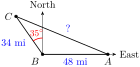
A triangle that is not a right triangle is called an oblique triangle. In this chapter we learn how to solve oblique triangles using the laws of sines and cosines. Just first nosotros must be able to find the sine, cosine, and tangent ratios for birdbrained angles.
Subsection Angles in Standard Position
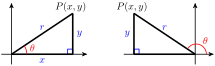
To extend our definition of the trigonometric ratios to obtuse angles, we use a Cartesian coordinate organisation. We put an angle \(\theta\) in standard position as follows:
-
Place the vertex at the origin with the initial side on the positive \(ten\)-centrality;
-
the terminal side opens in the counter-clockwise direction.
-
We choose a bespeak \(P\) on the terminal side of the angle, and form a right triangle by drawing a vertical line from \(P\) to the \(x\)-axis.
The length of the side adjacent to \(\theta\) is the \(x\)-coordinate of point \(P\text{,}\) and the length of the side opposite is the \(y\)-coordinate of \(P\text{.}\) The length of the hypotenuse is the distance from the origin to \(P\text{,}\) which we call \(r\text{.}\) With this annotation, our definitions of the trigonometric ratios are every bit follows.
Coordinate Definitions of the Trigonometric Ratios.
-
\(\displaystyle \cos \theta = \dfrac{x}{r}\)
-
\(\displaystyle \sin \theta = \dfrac{y}{r}\)
-
\(\displaystyle \tan \theta = \dfrac{y}{x}\)
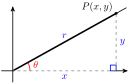
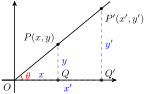
It doesn't affair which bespeak \(P\) on the terminal side we use to calculate the trig ratios. If we choose another indicate, say \(P^{\prime}\text{,}\) with coordinates \((x^{\prime number}, y^{\prime})\text{,}\) as shown at correct, we will get the same values for the sine, cosine and tangent of \(\theta\text{.}\) The new triangle formed is like to the beginning one, so the ratios of the sides of the new triangle are equal to the respective ratios in the first triangle.
Example 3.1 .
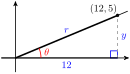
Notice the values of cos \(\theta\text{,}\) sin \(\theta\text{,}\) and tan \(\theta\) if the point \((12, 5)\) is on the last side of \(\theta\text{.}\)
Solution .
For the point \(P(12, v)\text{,}\) we accept \(10=12\) and \(y=five\text{.}\) Nosotros apply the distance formula to observe \(r\text{.}\)
\brainstorm{align*} r \amp = \sqrt{(2-0)^ii + (5-0)^2}\\ \amp = \sqrt{25+144} = \sqrt{169} = 13 \stop{align*}
The trig ratios are
\begin{align*} \cos \theta \amp = \dfrac{x}{r} = \dfrac{12}{13}\\ \sin \theta \amp = \dfrac{y}{r} = \dfrac{five}{13}\\ \tan \theta \amp = \dfrac{y}{10} = \dfrac{5}{12} \finish{align*}
Checkpoint three.three .
-
Find the equation of the last side of the bending in the previous example. (Hint: The terminal side lies on a line that goes through the origin and the point \((12,v)\text{.}\))
-
Show that the betoken \(P^{\prime}(24, 10)\) too lies on the final side of the angle.
-
Compute the trig ratios for \(\theta\) using the point \(P^{\prime number}\) instead of \(P\text{.}\)
Respond .
-
\(\displaystyle y = \dfrac{5}{12}x\)
-
\((24, 10)\) satisfies \(y = \dfrac{5}{12}10\text{,}\) that is, the equation \(10 = \dfrac{5}{12}(24)\) is truthful.
-
\(r^2 = 24^2 + 10^2 = 676\text{,}\) and then \(r = \sqrt{676} = 26.\) Then \(\cos \theta = \dfrac{x}{r} = \dfrac{24}{26} =\dfrac{12}{xiii},~~\sin\theta = \dfrac{y}{r} = \dfrac{10}{26} =\dfrac{5}{13}\text{,}\) and \(\tan\theta = \dfrac{y}{x} = \dfrac{10}{24} =\dfrac{5}{12}\text{.}\)
Activeness 3.1 . Obtuse Angles.
An obtuse angle has measure out betwixt \(90\degree\) and \(180\caste\text{.}\) In this section we will define the trigonometric ratios of an obtuse angle as follows.
-
Identify the angle \(\theta\) in standard position and choose a point \(P\) with coordinates \((x,y)\) on the final side.
-
The distance from the origin to \(P\) is \(\sqrt{ten^2+y^2}\text{.}\)
-
The trigonometric ratios of \(\theta\) are divers as follows.
The Trigonometric Ratios.
\brainstorm{equation*} \sin \theta = \dfrac{y}{r}~~~~~~~~\cos \theta = \dfrac{10}{r}~~~~~~~~\tan \theta = \dfrac{y}{ten} \end{equation*}
-
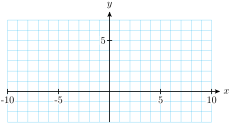
Draw an angle \(\theta\) in standard position with the signal \(P(6,iv)\) on its terminal side.
-
Find \(r\text{,}\) the altitude from the origin to \(P\text{.}\)
-
Calculate \(\sin \theta,~ \cos \theta\text{,}\) and \(\tan \theta\text{.}\) Requite both exact answers and decimal approximations rounded to four places.
-
Use the inverse cosine cardinal on your calculator to find \(\theta\text{.}\) Employ your calculator to verify the values of \(\sin \theta,~ \cos \theta\text{,}\) and \(\tan \theta\) that yous found in part (iii).
-
Draw another angle \(\phi\) in standard position with the point \(Q(-vi,four)\) on its terminal side. Explain why \(\phi\) is the supplement of \(\theta\text{.}\) (Hint: Consider the right triangles formed by drawing vertical lines from \(P\) and \(Q\text{.}\))
-
Tin can you use the right triangle definitions (using opposite, next and hypotenuse) to compute the sine and cosine of \(\phi\text{?}\) Why or why non?
-
Calculate \(\sin \phi,~ \cos \phi\text{,}\) and \(\tan \phi\) using the extended definitions listed above. How are the trig values of \(\phi\) related to the trig values of \(\theta\text{?}\)
-
Explain why \(\theta\) and \(\phi\) accept the same sine but different cosines.
-
Use the inverse cosine key on your reckoner to notice \(\phi\text{.}\) Use your calculator to verify the values of \(\sin \phi,~ \cos \phi\text{,}\) and \(\tan \phi\) that you lot found in function (7).
-
Compute \(180\degree-\phi\text{.}\) What respond should y'all await to go?
Subsection Trigonometric Ratios for Obtuse Angles
Our new definitions for the trig ratios work just as well for obtuse angles, even though \(\theta\) is not technically "inside" a triangle, because we use the coordinates of \(P\) instead of the sides of a triangle to compute the ratios.
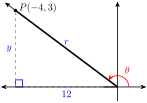
Discover first of all that because \(x\)-coordinates are negative in the second quadrant, the cosine and tangent ratios are both negative for obtuse angles. For case, in the effigy below, the bespeak \((-4, 3)\) lies on the terminal side of the bending \(\theta\text{.}\) We see that \(~~r = \sqrt{(-4)^ii + iii^ii} = 5~~\text{,}\) so
\begin{align*} \cos \theta \amp = \dfrac{x}{r} = \dfrac{-4}{5}\\ \sin \theta \amp = \dfrac{y}{r} = \dfrac{iii}{5}\\ \tan \theta \amp = \dfrac{y}{10} = \dfrac{3}{-4} = \dfrac{-three}{4} \end{align*}
Instance three.4 .
Notice the values of cos \(\theta\) and tan \(\theta\) if \(\theta\) is an obtuse angle with \(\sin \theta = \dfrac{1}{3}\text{.}\)
Solution .
Because \(\theta\) is obtuse, the terminal side of the angle lies in the second quadrant, as shown in the figure below. Because \(\sin \theta = \dfrac{1}{3}\text{,}\) we know that \(\dfrac{y}{r} = \dfrac{1}{3}\text{,}\) so we can cull a signal \(P\) with \(y=i\) and \(r=three\text{.}\) To find cos \(\theta\) and tan \(\theta\) we need to know the value of \(x\text{.}\) From the Pythagorean Theorem,
\begin{marshal*} ten^ii + one^2 \amp = iii^ii\\ x^2 \amp = iii^2 - 1^2 = 8\\ x \amp = -\sqrt{eight} \terminate{marshal*}
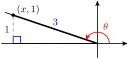
Remember that \(x\) is negative in the 2d quadrant! Thus
\begin{equation*} \cos \theta = \dfrac{10}{r} = \dfrac{-\sqrt{8}}{3}~~~~~ \text{and}~~~~~\tan \theta = \dfrac{y}{x} = \dfrac{-ane}{\sqrt{8}} \end{equation*}
Checkpoint iii.5 .
-
Sketch an birdbrained angle \(\theta\) whose cosine is \(\dfrac{-eight}{17}\text{.}\)
-
Find the sine and the tangent of \(\theta\text{.}\)
Answer .
-

-
\(\displaystyle \sin\theta = \dfrac{15}{17},~\tan\theta = \dfrac{-15}{eight}\)
Subsection Using a Calculator
In the examples higher up, we used a point on the final side to find exact values for the trigonometric ratios of obtuse angles. Scientific and graphing calculators are programmed with approximations for these trig ratios.
Example three.vi .
Notice the sine and cosine of \(130\caste\text{.}\) Compare to the sine and cosine of \(50\degree\text{.}\)
Solution .
Using a reckoner and rounding the values to 4 places, we find
\begin{align*} \sin 130\degree \amp = 0.7660 ~~~~~ \text{and}~~~~~ \cos 130\degree = -0.6428\\ \sin 50\degree \amp = 0.7660 ~~~~~ \text{and}~~~~~~~ \cos l\degree = 0.6428 \end{align*}
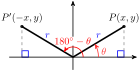
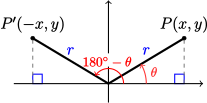
We see that \(\sin 130\caste = \sin 50\degree\) and \(\cos 130\degree = -\cos 50\degree\text{.}\) This upshot should not be surprising when nosotros expect at both angles in standard position, as shown below.
The angles \(50\degree\) and \(130\caste\) are supplementary. The right triangles formed by choosing the points \((x,y)\) and \((-10,y)\) on their last sides are congruent triangles.
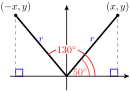
Consequently, the trigonometric ratios for \(50\degree\) and for \(130\degree\) are equal, except that the cosine of \(130\degree\) is negative.
Checkpoint iii.7 .
Employ your calculator to fill in the tabular array. Round to four decimal places.
| \(\theta\) | \(~~~~\cos \theta~~~~\) | \(~~~~\sin \theta~~~~\) | \(180\degree - \theta\) | \(\cos (180\degree - \theta)\) | \(\sin (180\degree - \theta)\) |
| \(10 \degree\) | \(~\) | \(~\) | \(~\) | \(~\) | \(~\) |
| \(20 \caste\) | \(~\) | \(~\) | \(~\) | \(~\) | \(~\) |
| \(30 \degree\) | \(~\) | \(~\) | \(~\) | \(~\) | \(~\) |
| \(forty \caste\) | \(~\) | \(~\) | \(~\) | \(~\) | \(~\) |
| \(l \degree\) | \(~\) | \(~\) | \(~\) | \(~\) | \(~\) |
| \(threescore \caste\) | \(~\) | \(~\) | \(~\) | \(~\) | \(~\) |
| \(lxx \caste\) | \(~\) | \(~\) | \(~\) | \(~\) | \(~\) |
| \(80 \degree\) | \(~\) | \(~\) | \(~\) | \(~\) | \(~\) |
Answer .
| \(\theta\) | \(~~~~\cos \theta~~~~\) | \(~~~~\sin \theta~~~~\) | \(180\degree - \theta\) | \(\cos (180\caste - \theta)\) | \(\sin (180\caste - \theta)\) |
| \(10 \degree\) | \(0.9848\) | \(0.1736\) | \(170\degree\) | \(-0.9848\) | \(0.1736\) |
| \(20 \degree\) | \(0.9397\) | \(0.3420\) | \(160\caste\) | \(-0.9397\) | \(0.3420\) |
| \(thirty \degree\) | \(0.8660\) | \(0.5\) | \(150\degree\) | \(0.8660\) | \(-0.v\) |
| \(xl \caste\) | \(0.7660\) | \(0.6428\) | \(140\degree\) | \(-0.7660\) | \(0.6428\) |
| \(l \degree\) | \(0.6428\) | \(0.7660\) | \(130\degree\) | \(-0.6428\) | \(0.7660\) |
| \(60 \degree\) | \(0.v\) | \(0.8660\) | \(120\degree\) | \(-0.v\) | \(0.8660\) |
| \(lxx \degree\) | \(0.3420\) | \(0.9397\) | \(110\degree\) | \(-0.9397\) | \(0.3420\) |
| \(80 \degree\) | \(0.1736\) | \(0.9848\) | \(100\degree\) | \(-0.9848\) | \(0.1736\) |
Subsection Trigonometric Ratios for Supplementary Angles
The examples to a higher place illustrate the following equations for supplementary angles. These iii equations are chosen identities, which means that they are true for all values of the variable \(\theta\text{.}\)
Trigonometric Ratios for Supplementary Angles.
-
\(\displaystyle \cos(180\degree - \theta) = -\cos \theta\)
-
\(\displaystyle \sin(180\caste - \theta) = \sin \theta\)
-
\(\displaystyle \tan(180\degree - \theta) = -\tan \theta \)
Example iii.9 .
Observe two different angles \(\theta\text{,}\) rounded to the nearest \(0.i \caste\text{,}\) that satisfy \(\sin \theta = 0.25\text{.}\)
Solution .
To observe an bending with \(\sin \theta = 0.25\text{,}\) nosotros summate \(\theta = \sin^{-1}(0.25)\text{.}\) With the estimator in degree mode, we press
\(\qquad\qquad\qquad\) 2nd SIN 0.25 ) ENTER
to find that one angle is \(\theta \approx 14.five \degree\text{.}\) Nosotros draw this acute bending in standard position in the first quadrant, and sketch in a correct triangle as shown beneath. In that location must as well be an birdbrained angle whose sine is \(0.25\text{.}\) To see the second angle, we draw a congruent triangle in the second quadrant equally shown.
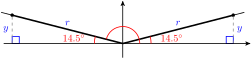
The supplement of \(fourteen.5 \degree\text{,}\) namely \(\theta = 180\caste - fourteen.5 \caste = 165.five\degree\text{,}\) is the obtuse angle we need. Discover that \(\dfrac{y}{r} = 0.25\) for both triangles, so \(\sin \theta = 0.25\) for both angles.
Checkpoint iii.10 .
Discover two different angles \(\theta\) that satisfy \(\sin \theta = 0.5\text{.}\)
Answer .
\(\theta = thirty\degree\text{,}\) \(~ \theta = 150\degree\)
Because there are two angles with the same sine, it is easier to observe an obtuse angle if nosotros know its cosine instead of its sine.
Case 3.11 .
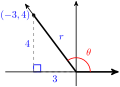
Find the angle shown at right.
Solution .
Using \(ten=-iii\) and \(y=4\text{,}\) we find
\begin{equation*} r=\sqrt{3^2 + 4^ii} = \sqrt{25} = 5 \end{equation*}
so \(\cos \theta = \dfrac{ten}{r} = \dfrac{-3}{5}\text{,}\) and \(\theta = \cos^{-1}\left(\dfrac{-3}{5}\right).\) Nosotros tin enter
\brainstorm{equation*} \text{2nd COS}~~~ -iii/5~ ) ~~~\text{ENTER } \end{equation*}
to run across that \(\theta \approx 126.9 \degree\text{.}\)
Checkpoint 3.13 .
-
Find the cosine of an obtuse angle with \(\tan \theta = -2\) .
-
Notice the angle \(\theta\) in role (a).
Reply .
-
\(\displaystyle \dfrac{-ane}{\sqrt{five}}\)
-
\(\displaystyle \theta \approx 116.565\caste\)
Subsection Supplements of the Special Angles
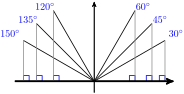
In Chapter ii we learned that the angles \(30\degree, 45\degree\) and \(60\caste\) are useful because we tin can find verbal values for their trigonometric ratios. The same is truthful for the supplements of these angles in the 2d quadrant, shown at right.
Example iii.14 .
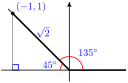
Find exact values for the trigonometric ratios of \(135 \degree\text{.}\)
Solution .
Nosotros sketch an bending of \(\theta = 135\caste\) in standard position, as shown beneath. The terminal side is in the 2d quadrant and makes an acute angle of \(45\caste\) with the negative \(x\)-axis, and passes through the point \((-1,i)\text{.}\) Thus, \(~r=\sqrt{(-1)^2 +1^2} = \sqrt{2}~\text{,}\) and we calculate
\begin{align*} \cos 135\degree \amp = \dfrac{x}{r} = \dfrac{-1}{\sqrt{two}}\\ \sin 135\degree \amp = \dfrac{y}{r} = \dfrac{1}{\sqrt{2}}\\ \tan 135\degree \amp = \dfrac{y}{x} = \dfrac{1}{-ane} = -1 \stop{align*}
Checkpoint 3.fifteen .
Notice exact values for the trigonometric ratios of \(120\degree\) and \(150\degree\text{.}\)
Respond .
| \(\theta\) | \(\cos\theta\) | \(\sin\theta\) | \(\tan\theta\) |
| \(120\degree\) | \(\dfrac{-ane}{ii} \) | \(\dfrac{\sqrt{3}}{2}\) | \(-\sqrt{3} \) |
| \(150\degree\) | \(\dfrac{-\sqrt{3}}{ii} \) | \(\dfrac{one}{two} \) | \(\dfrac{-1}{\sqrt{3}} \) |
Nosotros tin as well find the trig ratios for the quadrantal angles. These are the angles, including \(0\degree\text{,}\) \(xc\degree\) and \(180\caste\text{,}\) whose final sides lie on ane of the axes.
Example 3.16 .
Notice exact values for the trigonometric ratios of \(90\caste\text{.}\)
Solution .
The terminal side of a \(ninety\caste\) angle in standard position is the positive \(y\)-centrality. If we take the indicate \(P(0,1)\) on the last side as shown at right, then \(x=0\) and \(y=1\text{.}\) Although nosotros don't have a triangle, we tin can however calculate a value for \(r\text{,}\) the distance from the origin to \(P\text{.}\)
\begin{equation*} r = \sqrt{0^2 + 1^2} = 1 \terminate{equation*}

Our coordinate definitions for the trig ratios give u.s.
\brainstorm{equation*} \cos 90\caste = \dfrac{ten}{r} = \dfrac{0}{i}~~~~~ \text{and}~~~~~\sin 90\degree = \dfrac{y}{r} = \dfrac{1}{1} \end{equation*}
so \(~\cos xc\degree = 0~\) and \(~\sin 90\degree = 1~.\) Also, \(~\tan xc\degree = \dfrac{y}{x} = \dfrac{1}{0}~,\) so \(\tan 90\degree\) is undefined.
Checkpoint three.17 .
Find exact values for the trigonometric ratios of \(180\degree\text{.}\)
Reply .
\(\cos 180\degree = -1\text{,}\) \(~\sin 180\degree = 0\text{,}\) \(~\tan 180\degree = 0\)
Subsection The Area of a Triangle
The figure beneath shows part of the map for a new housing evolution, Pacific Shores. Yous are interested in the corner lot, number 86, and you lot would like to know the expanse of the lot in square feet. The sales representative for Pacific Shores provides you lot with the dimensions of the lot, merely yous don't know a formula for the surface area of an irregularly shaped quadrilateral.
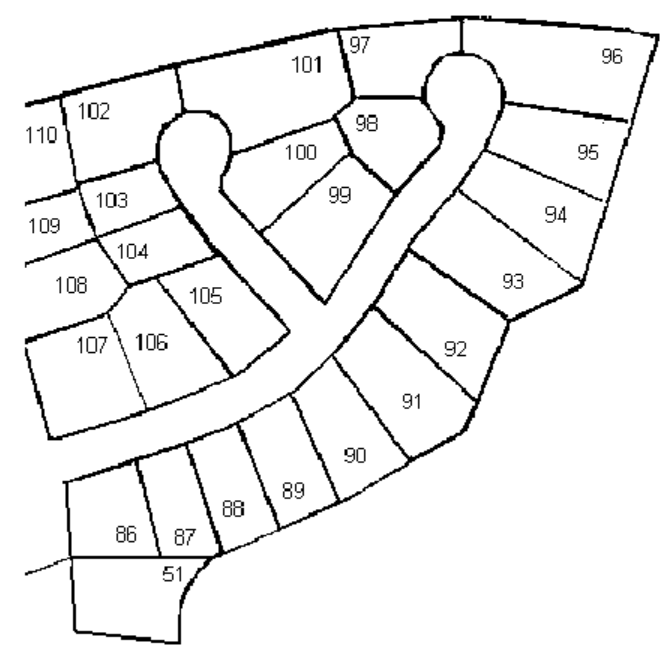
Information technology occurs to you that you can divide the quadrilateral into two triangles, and notice the expanse of each. At present, you know a formula for the area of a triangle in terms of its base and height, namely,
\begin{equation*} A = \dfrac{1}{2}bh\text{,} \stop{equation*}
only unfortunately, you don't know the pinnacle of either triangle.
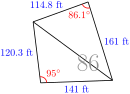
However, you can easily measure out the angles at the corners of the lot using the plot map and a protractor. You tin can bank check the values on the plot map for lot 86 shown higher up.
Using trigonometry, we tin discover the area of a triangle if we know two of its sides, say \(a\) and \(b\text{,}\) and the included angle, \(\theta\text{.}\) The effigy below shows iii possibilities, depending on whether the bending \(\theta\) is astute, birdbrained, or \(90\degree\text{.}\)
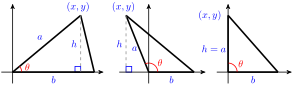
In each instance, \(b\) is the base of operations of the triangle, and its altitude is \(h\text{.}\) Our task is to find an expression for \(h\) in terms of the quantities nosotros know: \(a\text{,}\) \(b\text{,}\) and \(\theta\text{.}\) You should check that in all iii triangles
\begin{equation*} \sin \theta = \dfrac{h}{a} \stop{equation*}
Solving for \(h\) gives united states \(h = a\sin \theta\text{.}\) Finally, nosotros substitute this expression for \(h\) into our old formula for the area to get
\begin{equation*} A = \dfrac{1}{2}b~\blert{h} = \dfrac{1}{ii}b~ \blert{a\sin \theta} \end{equation*}
Surface area of a Triangle.
If a triangle has sides of length \(a\) and \(b\text{,}\) and the angle between those two sides is \(\theta\text{,}\) then the surface area of the triangle is given by
\begin{equation*} \blert{A = \dfrac{1}{2} ab \sin \theta} \end{equation*}

Example 3.18 .
Find the expanse of lot 86.
Solution .
For the triangle in the lower portion of lot 86, \(a = 120.three\text{,}\) \(b = 141\text{,}\) and \(\theta = 95\degree\text{.}\) The area of that portion is
\begin{align*} \text{First Area}\amp = \dfrac{1}{2}ab\sin \theta\\ \amp = \dfrac{ane}{ii} (120.3)((141)~\sin 95\degree \approx 8448.88 \end{marshal*}
For the triangle in the upper portion of the lot, \(a = 161\text{,}\) \(b = 114.8\text{,}\) and \(\theta = 86.i\caste\text{.}\) The surface area of that portion is
\begin{align*} \text{Second Area}\amp = \dfrac{1}{2}ab\sin \theta\\ \amp = \dfrac{1}{2} (161)((114.8)~\sin 86.i\caste \approx 9220.00 \end{align*}
The total expanse of the lot is the sum of the areas of the triangles
\begin{equation*} \text{Total area} = \text{First Area} + \text{Second Surface area}\approx 17668.88 \end{equation*}
Lot 86 has an area of approximately 17,669 foursquare feet.
Checkpoint 3.twenty .
A triangle has sides of length half dozen and 7, and the angle between those sides is \(150\degree\text{.}\) Find the area of the triangle.
Review the following skills you will demand for this department.
Algebra Refresher three.2 .
Notice the area of the triangle.
i.
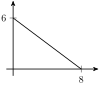
2.
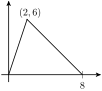
3.
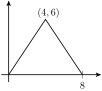
4.
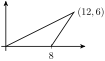
How many degrees are in each fraction of one complete revolution?
5. \(\:\dfrac{1}{4}\)
six. \(\:\dfrac{1}{five}\)
7. \(\:\dfrac{1}{half dozen}\)
8. \(\:\dfrac{one}{8}\)
\(\underline{\qquad\qquad\qquad\qquad}\)
Algebra Refresher Answers
-
\(\displaystyle 24\)
-
\(\displaystyle 24\)
-
\(\displaystyle 24\)
-
\(\displaystyle 24\)
-
\(\displaystyle 90\degree\)
-
\(\displaystyle 72\degree\)
-
\(\displaystyle sixty\caste\)
-
\(\displaystyle 45\degree\)
Subsection Section 3.one Summary
Subsubsection Vocabulary
-
Standard position
-
Initial side
-
Terminal side
-
Quadrantal angle
-
Oblique triangle
-
Quadrilateral
-
Identity
Subsubsection Concepts
-
We put an bending in standard position by placing its vertex at the origin and the initial side on the positive \(x\)-axis.
-
Coordinate Definitions of the Trigonometric Ratios.
-
\(\displaystyle \cos \theta = \dfrac{10}{r}\)
-
\(\displaystyle \sin \theta = \dfrac{y}{r}\)
-
\(\displaystyle \tan \theta = \dfrac{y}{x}\)
-
-
Trigonometric Ratios for Supplementary Angles.
-
\(\displaystyle \cos(180\degree - \theta) = -\cos \theta\)
-
\(\displaystyle \sin(180\degree - \theta) = \sin \theta\)
-
\(\displaystyle \tan(180\degree - \theta) = -\tan \theta \)
-
-
There are always 2 (supplementary) angles betwixt \(0\degree\) and \(180\degree\) that have the aforementioned sine. Your calculator will simply tell you ane of them.
-
Area of a Triangle.
If a triangle has sides of length \(a\) and \(b\text{,}\) and the angle between those 2 sides is \(\theta\text{,}\) then the surface area of the triangle is given by
\begin{equation*} A = \dfrac{ane}{2} ab \sin \theta \end{equation*}

Subsubsection Study Questions
-
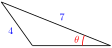
Delbert says that \(\sin \theta = \dfrac{4}{seven}\) in the figure. Is he correct? Why or why not?
-
Give the lengths of the legs of each correct triangle.
a.

b.

-
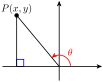
Explain why the length of the horizontal leg of the right triangle is \(-x\) .
-
Why are the sines of supplementary angles equal, just the cosines are non? What about the tangents of supplementary angles?
-
Use your computer to evaluate \(\sin 118\caste\text{,}\) so evaluate \(\sin^{-1} \text{ANS}\) . Explain the event.
-
Write an expression for the area of the triangle.

Subsubsection Skills
Practise each skill in the Homework Issues listed.
-
Use the coordinate definition of the trig ratios #iii-20, 45-48
-
Find the trig ratios of supplementary angles #7-10, 21-38
-
Know the trig ratios of the special angles in the 2d quadrant #21, 41-44
-
Find 2 solutions of the equation \(\sin \theta = k\) #29-38
-
Find the area of a triangle #49-58
Exercises Homework 3.1
ane.
Without using pencil and paper or a calculator, requite the supplement of each angle.
-
\(\displaystyle 30\degree\)
-
\(\displaystyle 45\degree\)
-
\(\displaystyle 120\degree\)
-
\(\displaystyle 25\caste\)
-
\(\displaystyle 165\degree\)
-
\(\displaystyle 110\degree\)
2.
Without using pencil and paper or a reckoner, requite the complement of each angle.
-
\(\displaystyle lx\caste\)
-
\(\displaystyle fourscore\degree\)
-
\(\displaystyle 25\degree\)
-
\(\displaystyle xviii\degree\)
-
\(\displaystyle 64\degree\)
-
\(\displaystyle 47\degree\)
Exercise Group.
For Problems three–6,
-
Give the coordinates of indicate \(P\) on the last side of the angle.
-
Find the altitude from the origin to indicate \(P\text{.}\)
-
Find \(\cos \theta,~~\sin \theta,\) and \(\tan \theta.\)
Exercise Group.
For Problems 7–10,
-
Find the sine and cosine of the angle.
-
Sketch the supplement of the angle in standard position. (Use congruent triangles.)
-
Observe the sine and cosine of the supplement.
-
Find the bending and its supplement, rounded to the nearest degree.
Practise Grouping.
For Issues eleven–20,
-
Sketch an angle in standard position with the given properties.
-
Find \(\cos \theta,~~\sin \theta,\) and \(\tan \theta.\)
-
Find the bending \(\theta \text{,}\) rounded to tenths of a degree.
11.
The point \((-v, 12)\) is on the terminal side.
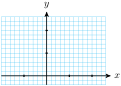
12.
The point \((12, 9)\) is on the terminal side.
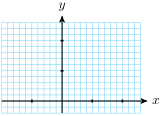
thirteen.
\(\cos \theta = -0.viii\)
xiv.
\(\cos \theta = \dfrac{5}{13}\)
15.
\(\cos \theta = \dfrac{3}{11}\)
16.
\(\cos \theta = \dfrac{-5}{six}\)
17.
\(\tan \theta = \dfrac{-1}{6}\)
18.
\(\tan \theta = \dfrac{9}{5}\)
19.
\(\tan \theta = 4\)
xx.
\(\tan \theta = -ane\)
21.
Fill up in exact values from memory without using a computer.
| \(\theta\) | \(~~~0\caste~~~\) | \(~~~30\degree~~~\) | \(~~~45\degree~~~\) | \(~~~60\degree~~~\) | \(~~~90\degree~~~\) | \(~~~120\degree~~~\) | \(~~~135\degree~~~\) | \(~~~150\degree~~~\) | \(~~~180\caste~~~\) |
| \(\cos \theta\) | \(~\) | \(~\) | \(~\) | \(~\) | \(~\) | \(~\) | \(~\) | \(~\) | \(~\) |
| \(\sin \theta\) | \(~\) | \(~\) | \(~\) | \(~\) | \(~\) | \(~\) | \(~\) | \(~\) | \(~\) |
| \(\tan \theta\) | \(~\) | \(~\) | \(~\) | \(~\) | \(~\) | \(~\) | \(~\) | \(~\) | \(~\) |
22.
Utilize your computer to fill in the table. Circular values to four decimal places.
| \(\theta\) | \(~~~15\degree~~~\) | \(~~~25\degree~~~\) | \(~~~65\degree~~~\) | \(~~~75\degree~~~\) | \(~~~105\degree~~~\) | \(~~~115\degree~~~\) | \(~~~155\caste~~~\) | \(~~~165\degree~~~\) |
| \(\cos \theta\) | \(~\) | \(~\) | \(~\) | \(~\) | \(~\) | \(~\) | \(~\) | \(~\) |
| \(\sin \theta\) | \(~\) | \(~\) | \(~\) | \(~\) | \(~\) | \(~\) | \(~\) | \(~\) |
| \(\tan \theta\) | \(~\) | \(~\) | \(~\) | \(~\) | \(~\) | \(~\) | \(~\) | \(~\) |
23.
For each bending \(\theta\) in the table for Trouble 22, the angle \(180\caste - \theta\) is too in the table.
-
What is true about \(\sin \theta\) and \(\sin (180\degree - \theta)\text{?}\)
-
What is true about \(\cos \theta\) and \(\cos (180\degree - \theta)\text{?}\)
-
What is true about \(\tan \theta\) and \(\tan (180\degree - \theta)\text{?}\)
Exercise Grouping.
For Problems 25–28,
-
Evaluate each pair of angles to the nearest \(0.one\degree\text{,}\) and prove that they are supplements.
-
Sketch both angles.
-
Find the sine of each angle.
25.
\(\theta = \cos^{-1} \left(\dfrac{three}{iv}\right)\text{,}\) \(~ \phi = \cos^{-1} \left(\dfrac{-three}{four}\right)\)
26.
\(\theta = \cos^{-1} \left(\dfrac{1}{5}\right)\text{,}\) \(~ \phi = \cos^{-i} \left(\dfrac{-1}{5}\right)\)
27.
\(\theta = \cos^{-1} (0.1525)\text{,}\) \(~ \phi = \cos^{-one} (-0.1525)\)
28.
\(\theta = \cos^{-1} (0.6825)\text{,}\) \(~ \phi = \cos^{-i} (-0.6825)\)
Exercise Grouping.
For Problems 29–34, find two different angles that satisfy the equation. Round to the nearest \(0.one\caste\text{.}\)
29.
\(\sin \theta = 0.7\)
thirty.
\(\sin \theta = 0.1\)
31.
\(\dfrac{\sin \theta}{6} = 0.14\)
32.
\(\dfrac{v}{\sin \theta} = vi\)
33.
\(4.8 = \dfrac{three.2}{\sin \theta}\)
34.
\(1.5 = \dfrac{\sin \theta}{0.3}\)
Practise Group.
For Problems 35–38, fill in the blanks with complements or supplements.
35.
If \(~\sin 57\degree = q~\text{,}\) so \(~\sin \underline{\hspace{2.727272727272727em}} = q~\) as well, \(~\cos \underline{\hspace{2.727272727272727em}} = q~\text{,}\) and \(~\cos \underline{\hspace{2.727272727272727em}} = -q\text{.}\)
36.
If \(~\sin 18\degree = w~\text{,}\) then \(~\sin \underline{\hspace{2.727272727272727em}} = w~\) also, \(~\cos \underline{\hspace{two.727272727272727em}} = w~\text{,}\) and \(~ \cos \underline{\hspace{two.727272727272727em}} = -w\text{.}\)
37.
If \(~\cos 74\degree = chiliad~\text{,}\) then \(\cos \underline{\hspace{2.727272727272727em}} = -k~\text{,}\) and \(~\sin \underline{\hspace{2.727272727272727em}}~\) and \(~\sin \underline{\hspace{2.727272727272727em}}~\) both equal \(m\text{.}\)
38.
If \(~\cos 36\degree = t~\text{,}\) then \(~\cos \underline{\hspace{2.727272727272727em}} = -t~\text{,}\) and \(~\sin \underline{\hspace{ii.727272727272727em}}\) and \(~\sin \underline{\hspace{ii.727272727272727em}}\) both equal \(t\text{.}\)
39.
-
Sketch the line \(y = \dfrac{iii}{four}10\text{.}\)
-
Find ii points on the line with positive \(x\)-coordinates.
-
The line \(y = \dfrac{iii}{4}ten\) makes an bending with the positive \(ten\)-axis. What is that angle?
-
Repeat parts (a) through (c) for the line \(y = \dfrac{-iii}{iv}x\text{,}\) except find 2 points with negative \(10\)-coordinates.
40.
-
Sketch the line \(y = \dfrac{five}{3}10\text{.}\)
-
Find two points on the line with positive \(x\)-coordinates.
-
The line \(y = \dfrac{5}{3}x\) makes an bending with the positive \(10\)-axis. What is that angle?
-
Repeat parts (a) through (c) for the line \(y = \dfrac{-5}{3}x\text{,}\) except find two points with negative \(ten\)-coordinates.
Exercise Group.
For Problems 41–44,
-
Find exact values for the base of operations and acme of the triangle.
-
Compute an exact value for the area of the triangle.
45.
Sketch an bending of \(120\degree\) in standard position. Detect the missing coordinates of the points on the terminal side.
-
\(\displaystyle (-i, ?)\)
-
\(\displaystyle (?, 3)\)
46.
Sketch an angle of \(150\caste\) in standard position. Observe the missing coordinates of the points on the terminal side.
-
\(\displaystyle (?, 2)\)
-
\(\displaystyle (-four, ?)\)
47.
Sketch an angle of \(135\caste\) in standard position. Find the missing coordinates of the points on the last side.
-
\(\displaystyle (?, three)\)
-
\(\displaystyle (-\sqrt{5}, ?)\)
48.
-
Use a sketch to explain why \(\cos 90\degree = 0\text{.}\)
-
Utilize a sketch to explicate why \(\cos 180\caste = ane\text{.}\)
Exercise Group.
For Issues 49–54, observe the area of the triangle with the given properties. Round your answer to two decimal places.
49.

l.

51.

52.

53.
\(b = two.5\) in, \(c = 7.6\) in, \(A = 138\degree\)
54.
\(a = 0.8\) m, \(c = 0.15\) m, \(B = xv\degree\)
55.
Notice the area of the regular pentagon shown at right. (Hint: The pentagon can be divided into five coinciding triangles.)

56.
Observe the area of the regular hexagon shown at right. (Hint: The hexagon can be divided into six congruent triangles.)

Exercise Group.
For Problems 57 and 58, lots from a housing evolution have been subdivided into triangles. Discover the full area of each lot by computing and adding the areas of each triangle.
57.
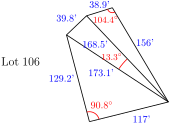
58.
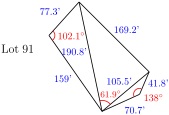
Exercise Group.
For Problems 59 and 60,
-
Detect the coordinates of point \(P\text{.}\) Circular to ii decimal places.
-
Detect the sides \(BC\) and \(PC\) of \(\triangle PCB\text{.}\)
-
Find side \(PB\text{.}\)
59.
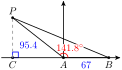
60.

61.
Subsequently we will be able to evidence that \(\sin eighteen\degree = \dfrac{\sqrt{v} - 1}{four}\text{.}\) What is the exact value of \(\sin 162\degree?\) (Hint: Sketch both angles in standard position.)
62.
Later on we will be able to show that \(\cos 36\caste = \dfrac{\sqrt{5} + 1}{4}\text{.}\) What is the exact value of \(\cos 144\degree?\) (Hint: Sketch both angles in standard position.)
63.
Alice wants an obtuse angle \(\theta\) that satisfies \(\sin \theta = 0.3\text{.}\) Bob presses some buttons on his estimator and reports that \(\theta = 17.46\degree\text{.}\) Explicate Bob'southward error and give a correct approximation of \(\theta\) accurate to two decimal places.
64.
Yaneli finds that the bending \(\theta\) opposite the longest side of a triangle satisfies \(\sin \theta = 0.8\text{.}\) Zelda reports that \(\theta = 53.13\caste\text{.}\) Explain Zelda's error and give a correct approximation of \(\theta\) accurate to two decimal places.
Exercise Group.
For Issues 65–70,
-
Sketch an bending \(\theta\) in standard position, \(0\degree \le \theta \le 180\degree\text{,}\) with the given properties.
-
Find expressions for \(\cos \theta, ~\sin \theta\text{,}\) and \(\tan \theta\) in terms of the given variable.
65.
\(\cos \theta = \dfrac{x}{three}, ~ 10 \lt 0\)
66.
\(\tan \theta = \dfrac{4}{\alpha}, ~ \blastoff \lt 0\)
67.
\(\theta\) is obtuse and \(\sin \theta = \dfrac{y}{2}\)
68.
\(\theta\) is obtuse and \(\tan \theta = \dfrac{q}{-seven}\)
69.
\(\theta\) is obtuse and \(\tan \theta = m\)
70.
\(\cos \theta = h\)

How To Find Obtuse Angle,
Source: https://yoshiwarabooks.org/trig/Obtuse-Angles.html
Posted by: gearhartruss1964.blogspot.com
0 Response to "How To Find Obtuse Angle"
Post a Comment